Systems of domination are so deep-rooted that we must wriggle free of our world to clearly see how they work. For instance, by changing the subject of a sentence, we can perceive the extent to which something that is humanly, ethically and morally intol-erable has become mundane. Let us, for example, replace “woman” with “man with green eyes” and tell the following story: “Once upon a time, there was a land where a rather chilling phenomenon was reported. Every other day or so, a person was killed by a family member. An investigation undertaken by trustworthy people found that the victims all shared the same distin-guishing physical feature: they were men with green or blue eyes. In effect, men with light-coloured eyes often were disdained in this land, and sometimes were openly mistreated, even in public. Of course, the question arose as to why these now murdered men with light-coloured eyes chose to remain with such abusive fami-lies. After delving deeper, it was found that many of them had in fact fled their fami-lies in fear of their lives, but their fami-lies pursued them and succeeded in killing them several months after they left.” The story does not say how men with green eyes managed... it simply shows the point to which something intolerable is completely trivialized when women are concerned...and at the moment, women are not managing at all.
According to UNODC, 87,000 women in the world were killed intentionally in 2017, meaning they were killed because they were women. Of these, 58% were killed by intimate partners or family members. This means that every day, 137 women are killed by a member of their own family. Every hour, six women are killed by someone they know. Over 60% of them are killed by a current or former intimate partner, someone with whom they once had a bond of trust and/or love.
As early as the 1970s, feminists understood that this type of homicide was related to being a woman, and called it “femicide”. At first strongly rejected, the term has gradu-ally become officially accepted. In 2006, the UN General Secretary defined “femicide” as “the gender-based murder of a woman” and the “murder of women because they are women”. And in 2012, the United Nations Special Rapporteur on Violence Against Women, Its Causes and Consequences, described “femicide” as “the culmination of pre-existing forms of violence, often expe-rienced in a continuum of violent acts”. This is because the notion of “femicide” is inex-tricably linked to violence against women, from the most ordinary kind, such as soci-ety’s subtle and systematic devaluation of women, to more extreme forms, such as mass rape and murder.
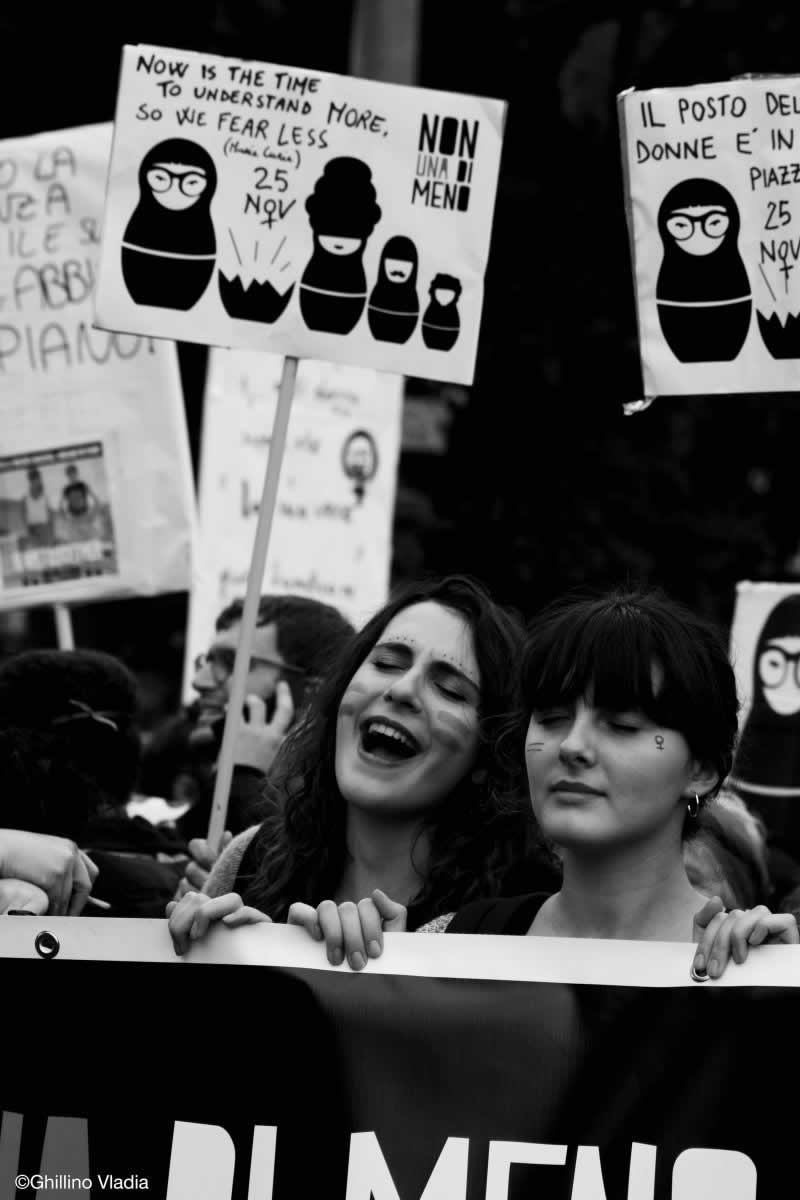
Kafa (meaning “enough”), and Non Una de Menos (meaning “not one less”) are amongst the names that an increasing number of women’s associations have adopted to put a face and life stories on cold statistics. In so doing, they are trying to restore to these female humans the value that was stolen from them even before their lives were taken. For them, it is too late. But many, many women (35% of all women in the world) continue to wake up each morning wondering where the first blow will fall, and whether the man with whom they have chosen – for the most part – to live will carry out his threats. To avoid a fresh humiliation, or a new blow, they give up part of themselves, become smaller, and reduce their ability to imagine themselves elsewhere. For these women, every day is a living hell, and these tranquil households, which seem so peaceful and safe, are actually torture chambers from which they cannot escape because outside there are few places where their lives will be taken seriously. In our society, half of which is female, many women have experienced this hell or will live in it one day. We pass them on the street every day. They are among us. They are us.